Before the Phones Come Out: The Shared First Order That Makes a Blyth Night Work
Picture the scene. It is a Saturday in Blyth, the air has that November bite, and six people have just pushed through the door at Bar 38. Coats come off. Someone says they are only having one. Someone else is already scrolling the drinks menu on their phone. Then comes the small decision that quietly decides the whole night: who is ordering first, and are they ordering for everyone?
The first round is never just a drink. It is the moment a loose collection of people becomes a table. It is the icebreaker that does not feel like an icebreaker, because nobody has to announce it. You just do it. At Bar 38, that shared first order sets the pace for everything that follows — the conversation, the mood, the likelihood that anyone checks their phone in the next twenty minutes.
The round is a small piece of theatre
There is a reason a group order feels different from a solo one. It has a beginning, a middle and an end. Someone gathers the requests. Someone else counts heads. There is the usual negotiation over who is on the lager, who wants something dark, who is driving and who is on the soft drinks. By the time the drinks land, everyone has already spoken to each other. That is the trick of it. The first round does the social work before the conversation has properly started.
Compare that with the split approach. One person goes to the bar. Two more follow. Someone stays at the table guarding coats and looking at their phone. By the time everyone has a drink, the group has fragmented into little islands. The night can still be good, but it starts late. A shared order starts it now.
Why the first order changes the pace
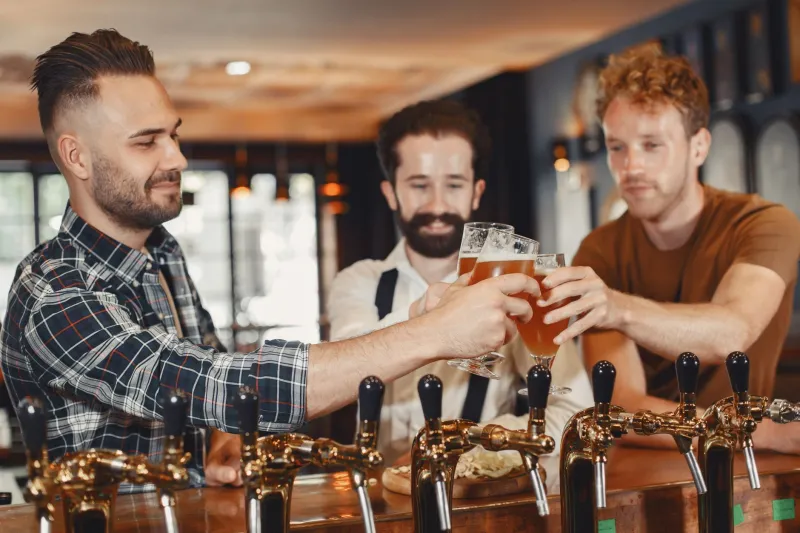
Drinks that arrive together get drunk together. That sounds obvious, but it matters. The first sip becomes a shared moment. Glasses meet. Someone says cheers. Someone else makes a face at how strong the stout is. The table has a common experience to react to, and that is far more sociable than five people arriving at their first drink at five different times.
At Bar 38, the bar staff are used to the rhythm of a Blyth night out. They know when a big table is settling in and when a quick round is really a quick round. Order together and you give them a clear job: six drinks, one tray, one moment. Order in dribs and drabs and everyone waits a little longer, including you. The shared order is not just friendlier; it is more efficient.
Big groups: keep it simple, keep it kind
Large tables can turn a first round into a committee meeting. The trick is to keep the decision small. Nominate one person to take the order, but make sure they actually ask the table rather than guessing. Give everyone ten seconds to choose. If the group is bigger than eight, split the order into two waves — one person takes the first four drinks, someone else takes the next four. That way nobody is standing at the bar for fifteen minutes while the rest of the table forgets what they wanted.
It also helps to order something for the table, not just for individuals. A jug of water and a couple of bowls of bar snacks cost very little and make the table feel like a place people want to stay. At Bar 38, a shared plate of something salty is often the difference between a quick pint and a proper start to the night. Keep it kind, too: if someone asked for a soft drink, do not swap it for a pint because it is easier to carry. The first round is a small act of listening.
Indecisive friends: give them a shortlist
Every group has one. The friend who reads the menu like it is a legal document. The friend who says they will have whatever you are having, then changes their mind when they see yours. The friend who wants a cocktail but only if it is not too sweet, too sour, too strong or too pink.
Do not let indecision become a group activity. Give them a shortlist. Ask the bar what is pouring well and offer three options: a lager, a house red, a gin and tonic, or a soft drink. If they still cannot choose, order them something sensible and tell them they can pick the next one. That is not bossy; it is merciful. The first round is there to get the night moving, not to hold it hostage.
Keeping the round fair
Money can make people strange. A round is meant to be generous, not a spreadsheet. The simplest system is the old one: one person or one couple buys the first round, then someone else takes the second, and so on. If someone joins late, they buy the next round. If someone is not drinking, they can buy the snacks or the soft drinks. Nobody needs to keep a tally to the penny.
If the group is large or the night is long, a loose rotation works better than a strict one. Say out loud who is getting the next round, and then let it go. The point is not perfect accounting. The point is that everyone feels included and nobody feels like they are constantly chasing the bar. A fair round is a relaxed round.
The first round is a mood, not a transaction
The first order is the moment the night decides what it is going to be. If everyone orders separately and drifts back to their phones, the night starts as a series of small errands. If everyone orders together, it starts as a table. That is the whole argument. The first round is not about the drink. It is about the signal you send: we are here, we are doing this together, and the phones can wait.
So next time you are out in Blyth, before anyone splits off to the bar, gather the order. One tray, one table, one start. The rest of the night will thank you for it.